Longevity intelligence · Australia
Normal is a range.
Health is a direction.
Five results from one Australian pathology report. Every one cleared the laboratory’s range, so the report came back normal. Vector reads them together — and what they say together is the part nobody tells you.
- Free to start
- 82 biomarkers
- Australian report units
- No ad or analytics SDKs
Example record
Collected 12 June 2026
Fasting Glucose
5.4mmol/LFasting Glucose: 5.4 mmol/L. Reference interval 3 to 5.5 mmol/L. Inside the interval.
HbA1c
40mmol/molHbA1c: 40 mmol/mol. Reference interval 20 to 41 mmol/mol. Inside the interval.
Fasting Insulin
16mU/LFasting Insulin: 16 mU/L. Reference interval 2 to 25 mU/L. Inside the interval.
Triglycerides
1.8mmol/LTriglycerides: 1.8 mmol/L. Reference interval 0.5 to 2 mmol/L. Inside the interval.
HDL Cholesterol
1.0mmol/LHDL Cholesterol: 1.0 mmol/L. Reference interval 1 to 2.5 mmol/L. Inside the interval.
5 of 5 in range
Then Vector reads them together.
The cheaper way in
You don't need a membership. You need your results, organised.
Longevity programs bundle testing, imaging and clinical time into one annual fee. Most Australians have already had the bloods through their GP, and already have a doctor who knows them. What is missing is the part that holds those results together — and that part starts at nothing.
Compare with a longevity clinic- Track your own reports
- $0
- Vector Premium
- $9.99/month
- Need new bloods?
- $99one-off
All 82 biomarkers, your full history, no trial clock.
The doctor report, the projection and the full plan.
An optional Australian panel. Never required to use Vector.
The real economics
The blood test was never the expensive part. The conversation was.
A longevity program's fee mostly buys you a doctor who will sit down and read your bloods to you. In Australia that conversation is already available, and for most people it is already free — what is missing is someone doing the reading beforehand. That is the job Vector does.
See the report you take in- Australian GP visits bulk billed
- 81.4%
- What Vector charges to find the patterns
- $9.99/month
- What the appointment then costs you
- $0*
Nationwide, across the three months from 1 November 2025.
Or nothing at all, if you only want the tracked record.
*At a bulk-billing practice. 3,700+ are registered.
Bulk billing figures: Department of Health, Disability and Ageing.
From report to record
One report is a snapshot. Vector makes it a series.
Most people collect PDFs in an inbox and compare them from memory. Vector reads the report, hands the values back to you to check, then keeps them in one place so the next one has something to be compared against.
Bring in what you already have
The app reads a PDF, scan or photo of an Australian pathology report and pulls out the values, units and collection date. If the file is on a computer, the secure handoff sends it across without signing in on that machine.
Check it before it is saved
Extraction gets a review step, not a rubber stamp. Every value, unit and date is editable, and nothing joins your record until you accept it.
Watch the direction
Once there is more than one report, each marker has a trend, body systems have a shape, and the biological age estimate has a direction rather than a single figure.
The Longevity Vector
A number tells you where you are. A vector tells you where you're headed.
Vector estimates biological age from your blood markers, then reads it against your chronological age over successive reports. The distance between those two lines — and which way it is moving — is the thing worth following.
How biological age tracking works- Reports in this record
- 8
- Latest estimate
- 30.3years
- Chronological
- 32.0years
Example record. The estimate is built on a published biological-age foundation, standardised against an age- and sex-matched population, and stated with the confidence its inputs support.
Read the methodology82 biomarkers
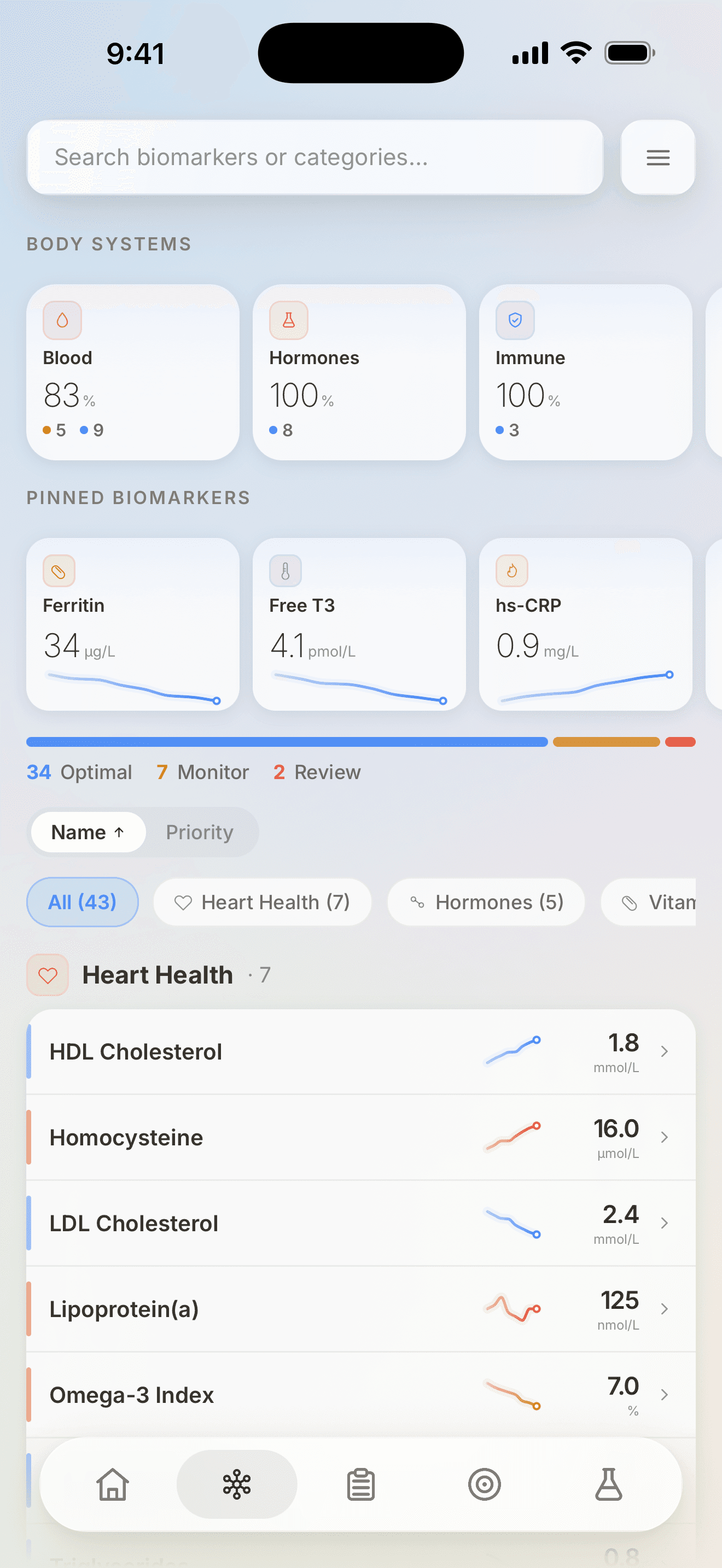
The library underneath the headline.
Every marker Vector can track has a page: what it measures, the unit Australian laboratories print it in, what can move it, and which results are worth reading beside it.
Browse the biomarker library10 markers
Heart Health
Lipids, particles and related markers that help you follow cardiovascular context over time.
Explore heart health5 markers
Blood Sugar
Markers of glucose regulation and the insulin response, shown in Australian units.
Explore blood sugar12 markers
Hormones
Sex, adrenal and growth hormones whose interpretation depends on timing and personal context.
Explore hormones4 markers
Thyroid
Thyroid hormones and antibodies that are interpreted together rather than in isolation.
Explore thyroid4 markers
Inflammation
Immune and clotting signals that can change with illness, training and recovery.
Explore inflammation15 markers
Full Blood Count
Red-cell, white-cell and platelet measures from a full blood count.
Explore full blood countVector Premium
Two paths, twelve months out.
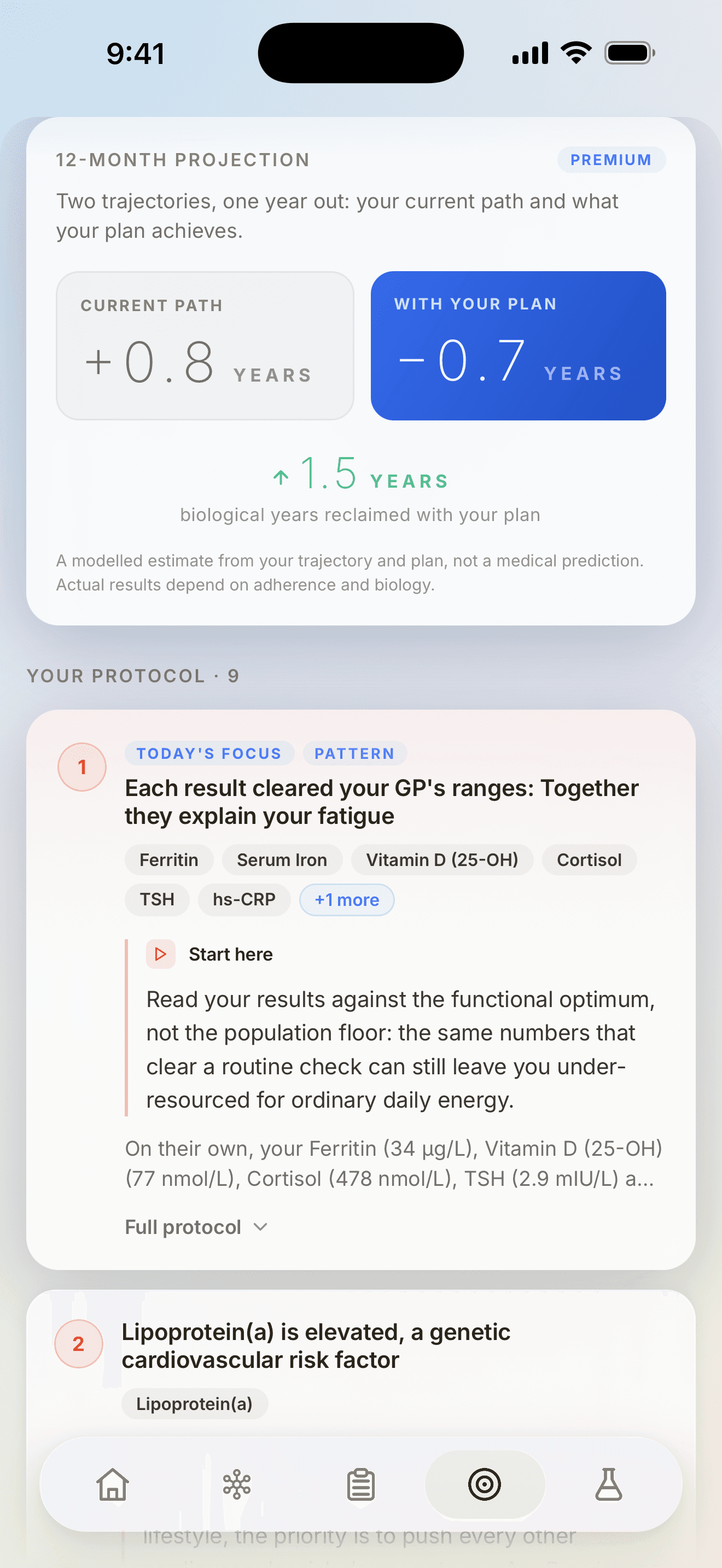
Premium models where your record goes if nothing changes, and where it goes if you follow the plan Vector builds from it. The gap between them is the part you control.
See what Premium includes- Continuing as you are
- +0.8years
- Following your plan
- −0.7years
- Modelled difference
- 1.5years
How it is modelled
Projected from your own trajectory and the plan Vector builds from it. What actually happens depends on adherence and on biology.
Premium is 9.99 AUD a month or 79.99 AUD a year. The record itself is free.
Take it to your GP
One page that turns a ten-minute appointment into a real conversation.
Premium exports your record as a branded PDF: the patterns Vector identified, what changed and when, every measured biomarker with its unit and date, and up to six questions worth asking. You arrive with the whole history assembled instead of the latest PDF.
See what's in the report- Findings first, then the complete measured record underneath.
- Every claim tied to a reading and a collection date.
- States its own coverage, so a thin record looks thin.
What Vector noticed
Every metabolic result cleared the lab. Together they indicate insulin resistance.
Glucose is only sitting in range because insulin is running near the top of its own. Triglycerides are high and HDL is at its floor — the combination that precedes type 2 diabetes by years, and the one a glucose test on its own will not show.
- Fasting Insulin16mU/L
- Triglycerides1.8mmol/L
- HbA1c40mmol/mol
- Fasting Glucose5.4mmol/L
- HDL Cholesterol1.0mmol/L
Questions for your GP
- My insulin has doubled while glucose held steady — is that worth acting on now?
- Would a HOMA-IR or an oral glucose tolerance test add anything here?
In the app
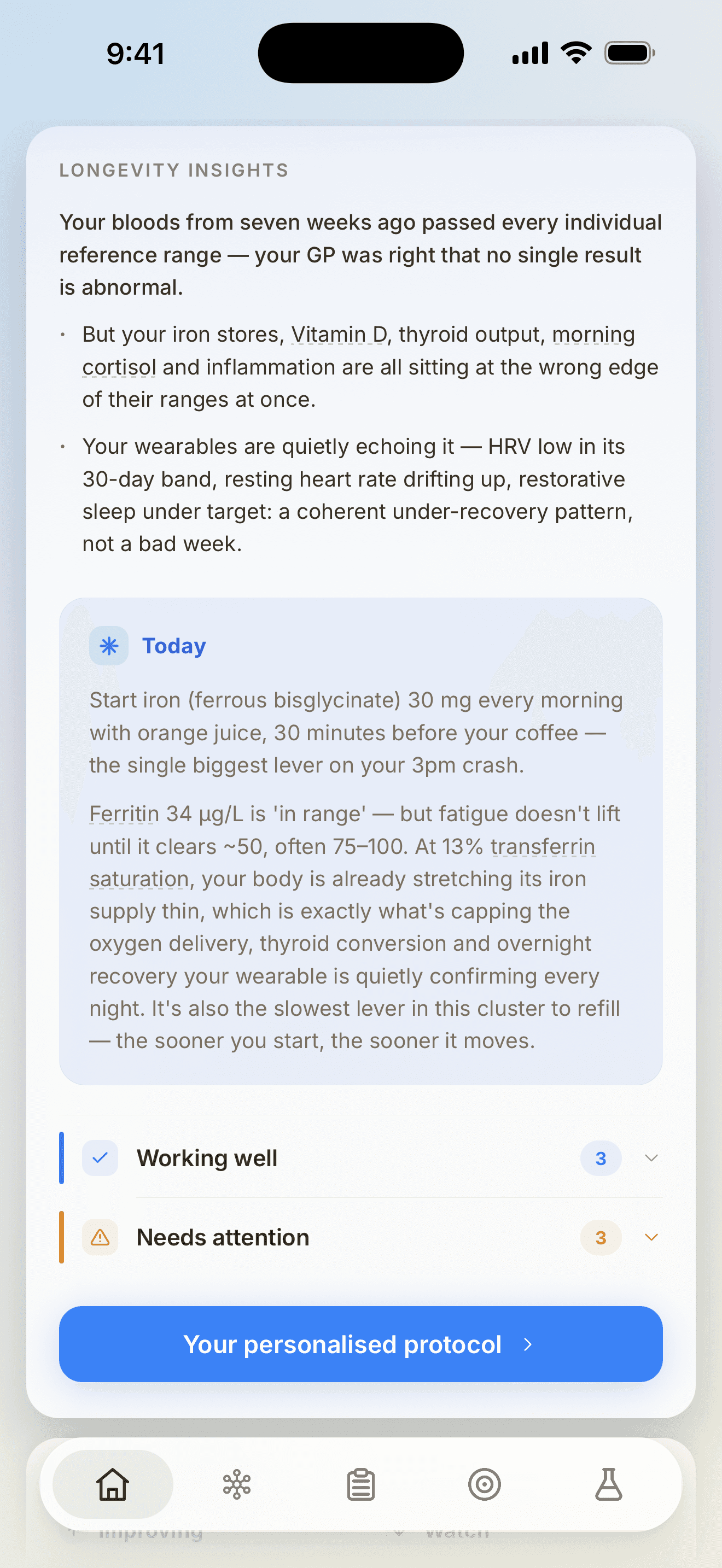
Built for the report you actually received.
Australian units, the labels your laboratory prints, and the collection date kept beside every value.
Explore the product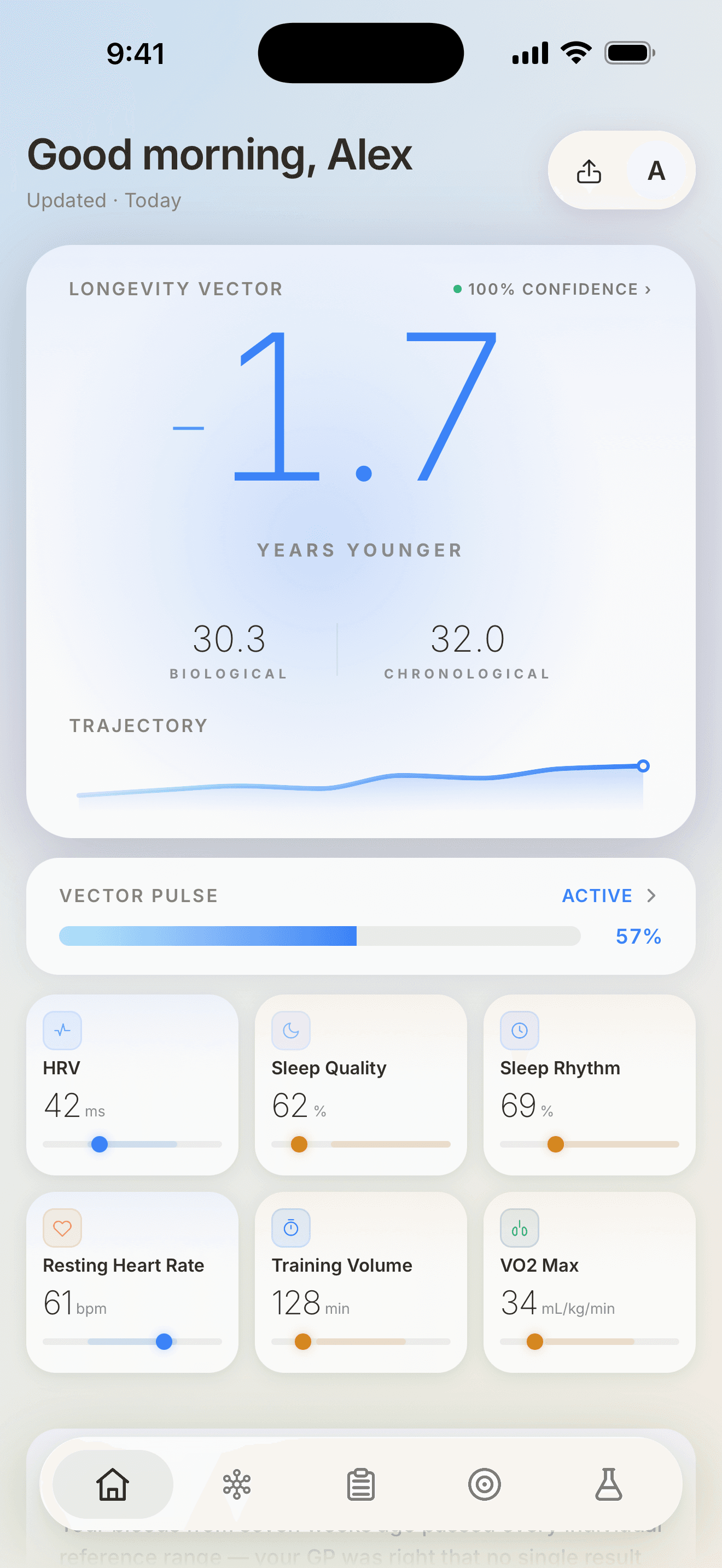
Privacy
Health data, held like health data.
Vector carries no third-party advertising or analytics SDKs. High-granularity sleep and workout data stays on your device, and the website never parses a report — files handed over from a computer go straight to your own account for the app to process.
How Vector handles your data- No third-party advertising or analytics SDKs in the app.
- Reports are stored in a private, per-account bucket.
- Source files are cleaned up once results are saved.
- You review every extracted value before it is kept.
Questions
Answers, before you download.
What does Vector do with a pathology report?
Vector reads the report and turns it into tracked results. The app extracts each supported marker with its value, unit and collection date from a PDF, scan or photo, shows you an editable review, and saves only what you accept. From then on that marker has a history rather than a single reading.
Do I need a new blood test to start?
No. Vector is built for the reports you already have, and a single past report is enough to begin. Adding older reports gives the record more history immediately, and each new one adds a dated point to it.
Does Vector work with Australian pathology reports?
Yes — Australian reports are what Vector is built for. It keeps the units Australian laboratories print, such as mmol/L for cholesterol and nmol/L for vitamin D, and uses the marker names that appear on local reports rather than converting them to overseas conventions.
How does Vector estimate biological age?
Vector estimates biological age from your blood markers using a published, peer-reviewed foundation, then standardises the result against an age- and sex-matched population so the figure is not skewed for younger adults. The estimate is shown with a confidence level reflecting how much of your data it had, and the direction it moves across reports matters more than any single value.
Is Vector a diagnosis, or medical advice?
No. Vector organises the results you already have so they are easier to follow and easier to discuss at an appointment. It reads your reports, tracks every supported marker over time, and produces a summary you can hand your GP — the interpreting is theirs to do.
What does Vector cost?
The record is free. Importing reports, tracking all 82 biomarkers, browsing body systems and following your history cost nothing. Vector Premium is 9.99 AUD a month or 79.99 AUD a year (prices checked 2 August 2026) and adds the twelve-month projection, the full personalised plan and daily AI synthesis. Optional Australian pathology panels are priced separately from the subscription.
Do I need an Apple Watch?
No. Apple Health data is optional context, not a requirement. If you do connect it, Vector reads signals such as resting heart rate, heart rate variability and sleep to fill the gaps between reports; without it, the record runs on your pathology results alone.
What happens to my health data?
It stays in your own account and is never sold. Vector carries no third-party advertising or analytics SDKs, high-granularity sleep and workout data stays on your device, and report files are held in a private per-account store and cleaned up once their results are saved.
Start with the bloods you have already paid for.
Importing your reports and tracking all 82 biomarkers is free. Decide about Premium once your record has something in it worth projecting.